Advertising Compliance Resource Center

Stay informed and compliant with expert guidance, articles, webinars, and tools from ComplyAuto — the leader in dealership compliance automation.


Your Trusted Source for Federal Advertising Compliance

Recent FTC enforcement actions — including the 97 warning letters sent to dealers in March 2026 — are a clear signal: regulators are paying close attention to advertising, disclosures, and overall compliance practices.

This Resource Center is designed to help dealerships understand what’s happening, what it means, and what to do now.

Whether you’re reviewing your current processes or looking to strengthen your compliance posture, you’ll find practical guidance and tools here.

Stay Ahead of FTC Enforcement Activity

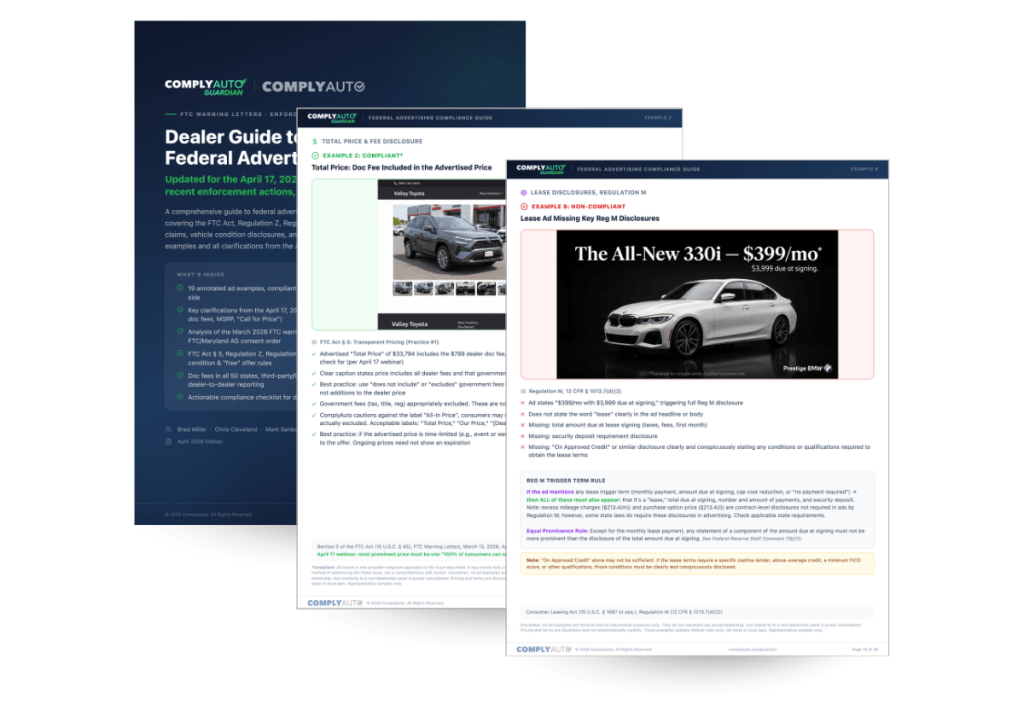
Download ComplyAuto’s Comprehensive Dealer Guide to Federal Advertising, updated for the April 17, 2026, NADA-FTC Webinar, recent enforcement actions, and 2026 FTC warning letters.

Under the FTC Microscope

On March 13, 2026, the FTC sent warning letters to 97 auto dealership groups nationwide targeting deceptive pricing practices under Section 5 of the FTC Act. On the April 17, 2026 NADA-FTC webinar, FTC staff confirmed the letters were not sent for technical or borderline issues. The common thread was advertising a total price while burying material conditions in fine-print disclaimers, and in some cases failing to post a total price at all.

In April 2026, the FTC and Maryland AG obtained a stipulated consent order against a Maryland-based dealership group, $3.1M in civil penalties plus an estimated $75M in consumer restitution. Three individuals (the owner and two managers) were named personally and held jointly and severally liable. The order requires “Total Price” as the most prominent item in all advertising and mandates “Express, Informed Consent” before any consumer charge.

The FTC frequently partners with state attorneys general because the FTC Act limits the Commission’s ability to obtain monetary penalties before a consent order is entered. State UDAP statutes, by contrast, typically authorize civil penalties and restitution from the outset of an enforcement action. That authority is what enabled the joint FTC/Maryland regulators to secure monetary relief at the filing stage.

Illegal Pricing Practices

The FTC warning letters identify six categories of illegal pricing practices. These are listed as examples, not an exhaustive list.

1. Prices That Don’t Reflect All Required Fees

Doc fees, destination charges, service fees, processing charges, dealer fees, filing fees, regardless of the label. If the dealer requires it, it must be in the advertised price.

Only government-required fees (taxes, title, registration) may be excluded. The April 2026 consent order defines “Total Price” as the maximum total price including all mandatory fees, and requires it be the most prominently displayed item in any ad.

2. Prices Reflecting Unavailable Rebates/Discounts

Advertised prices cannot “net out” rebates or discounts that are not available to ALL consumers. Military, loyalty, EV, and Costco rebates cannot be factored into the price.

You may list limited rebates separately with clear, conspicuous disclosure of conditions.

3. Prices That Hide a Required Down Payment

Cannot bury a required down payment or trade-in requirement in fine print. The advertised price must be achievable without hidden conditions.

Includes guaranteed trade-in allowance requirements.

4. Prices Conditioned on Dealer Financing

Cannot advertise a lower price that is only available if the consumer uses the dealer’s financing. This acts like a conditional discount not available to all buyers.

Finance-contingent discounts may be noted separately but not baked into the price.

5. Mandatory Add-Ons Not in the Price

If a consumer must purchase an item to buy the vehicle, its cost must be included in the advertised price. This includes hard-added accessories like theft deterrent, window tint, lift kits, and wheel mods.

Truly optional add-ons may be excluded only if genuinely optional. The April 2026 consent order requires “Express, Informed Consent”, written disclosure of what the charge is for, its amount, and whether it’s optional, before any charge.

6. Advertising Unavailable Vehicles

Cannot advertise vehicles that are not available for purchase. “Phantom” loss-leader ads that draw consumers in for vehicles that don’t exist or aren’t on the lot are deceptive.

In-transit vehicles may be advertised but status must be clearly and conspicuously disclosed.

1. Prices That Don’t Reflect All Required Fees

Doc fees, destination charges, service fees, processing charges, dealer fees, filing fees, regardless of the label. If the dealer requires it, it must be in the advertised price.

Only government-required fees (taxes, title, registration) may be excluded. The April 2026 consent order defines “Total Price” as the maximum total price including all mandatory fees, and requires it be the most prominently displayed item in any ad.

2. Prices Reflecting Unavailable Rebates/Discounts

Advertised prices cannot “net out” rebates or discounts that are not available to ALL consumers. Military, loyalty, EV, and Costco rebates cannot be factored into the price.

You may list limited rebates separately with clear, conspicuous disclosure of conditions.

3. Prices That Hide a Required Down Payment

Cannot bury a required down payment or trade-in requirement in fine print. The advertised price must be achievable without hidden conditions.

Includes guaranteed trade-in allowance requirements.

4. Prices Conditioned on Dealer Financing

Cannot advertise a lower price that is only available if the consumer uses the dealer’s financing. This acts like a conditional discount not available to all buyers.

Finance-contingent discounts may be noted separately but not baked into the price.

5. Mandatory Add-Ons Not in the Price

If a consumer must purchase an item to buy the vehicle, its cost must be included in the advertised price. This includes hard-added accessories like theft deterrent, window tint, lift kits, and wheel mods.

Truly optional add-ons may be excluded only if genuinely optional. The April 2026 consent order requires “Express, Informed Consent”, written disclosure of what the charge is for, its amount, and whether it’s optional, before any charge.

6. Advertising Unavailable Vehicles

Cannot advertise vehicles that are not available for purchase. “Phantom” loss-leader ads that draw consumers in for vehicles that don’t exist or aren’t on the lot are deceptive.

In-transit vehicles may be advertised but status must be clearly and conspicuously disclosed.

Doc Fees — Federal Law Controls in All 50 States

The FTC confirmed on the April 17 NADA-FTC webinar that federal law controls on doc fees in every state. No state actually requires a dealer to charge a doc fee, state laws only authorize the fee. Because federal law requires all mandatory dealer fees to be in the advertised price, the doc fee must be in the price regardless of state law. State law may still require itemization (separate disclosure of the fee amount), that is permitted alongside Total Price.

Protect Your Dealership with Guardian

ComplyAuto Guardian combines AI-powered ad scanning with a comprehensive compliance rule engine covering 12 federal and state rule categories across all 50 states, so every ad is checked before it goes live.

AI-Powered Ad Scanning

  • Scan any ad by text, image, or URL with 2,500+ compliance checks 
  • 4-tier risk assessment: clear violation, arguable, technical, and pass 
  • Evidence citations with exact ad text quotes and legal references

Rule Coverage

  • 12 rule groups: pricing, Reg Z, Reg M, rebates, UDAP, vehicle condition, availability, and more 
  • All 50 states plus federal rules with full legal citations 
  • Enforcement-contextaware: factors in state AG activity levels

Monitoring & Workflow

  • Automated website VDP monitoring for every vehicle 
  • Real-time violation alerts with fix recommendations 
  • Executive dashboard with trend charts and severity breakdowns

Featured Resources

Ready to get started?

FTC enforcement activity isn’t slowing down—but with the right tools and processes, you can stay prepared.

Company Footprint

#1

Recommended Compliance Solution

10,000+

Active Dealers Nationwide

44/50

State Dealer Association Endorsements

200+

Years of Combined Automotive and Legal Experience

Scroll to Top