
By Hao Nguyen, Esq.
Senior Product and Regulatory Counsel
The topic of electric vehicles (EVs) – you get it from your OEMs, your friends, your customers, and maybe even your family: What are the inventory levels? Will we meet the federal mandate? Will the infrastructure be able to handle it? Can you help me out on a sweet deal? (No?…Bueller?) I’m sure you’re all tired of hearing about EVs by now, but I am here to bring you both good news and bad news. The bad news is that this article is about EVs (boo), but the good news is that it’s probably not about any of the issues identified above. It’s actually a fairly volatile article, but we are going to use it as a learning event to help us prepare for any such incendiary instance that may arise.
The Cow Says “Moo,” The EV Says “Boo…m”
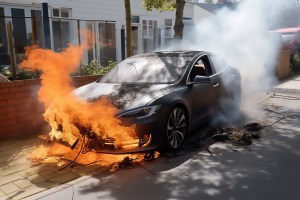 Last month, a dealership in Charleston, West Virginia experienced something that their staff will never forget. On a quiet Saturday afternoon at about 4:30 pm, dispatchers received a call about an electric vehicle that caught fire while it was in a local dealership’s service department. Thankfully no one was hurt as the vehicle was towed outside of the building and suppression efforts were successful. Though the details were fairly vague, we have a good idea of the culprit here: thermal runaway. Thermal runaway is the largest concern for EVs.
What is “Thermal Runaway”?
“Thermal runaway” is a phenomenon that occurs when the interior temperature of the lithium-ion battery cell rises rapidly and causes a chemical reaction inside the battery. This reaction releases the stored energy very suddenly (in the form of heat) which drives the internal temperature of the battery higher. This causes further chemical reactions that create even more heat. This process continues and can cause extremely high temperatures, as much as 752 degrees Fahrenheit (or 400 degrees Celsius), which can cause gassing of the battery and a fire that is so hot it can be nearly impossible to put out.
What Causes “Thermal Runaway”?
Thankfully, technology has gotten better, allowing manufacturers to create safer batteries in electric vehicles that prevent these types of chemical reactions. However, thermal runaway may still occur in some very rare cases (like in the instance above). Here are a few things you should be aware of to prevent thermal runaway.
- Physical damage: Thermal runaway can occur due to an internal short circuit caused by physical damage to the lithium-ion battery.
- Overcharging: Overcharging a battery beyond its safe maximum voltage can permanently damage the battery. This may not happen on the first occurrence, but consistently overcharging the battery can damage it significantly and lead to thermal runaway.
- Rapid charging: Rapid charging provides large amounts of currents in a short amount of time to the battery to charge it more quickly. This can lead to excessive currents, which in turn can stress the battery’s capacity. Just as in the case of overcharging, rapid charging a lithium-ion battery multiple times can permanently damage the battery.
- Outside temperature: Temperatures outside, in either cold or hot extremes, can permanently degrade the battery’s performance and integrity. The method of charging, previously considered safe prior to this degradation, can now become overly burdensome on the battery and lead to this chemical reaction.
Dealership Precautions
Dealerships that have EVs on premises should scrutinize their intake and storage processes and take proper precautions in handling these vehicles (and even lithium-ion batteries as replacement parts) to ensure a safe workplace for all their employees. Here are a few things that dealers should consider that may pose the highest risk to your dealership.
Service Department and PPE
Dealers should review their processes when servicing EVs and consult OEM guidelines on the specific vehicles as necessary. Additionally, staff should expect that not all EVs that come into their service departments are created equal because the integrity of the lithium-ion battery can be heavily influenced by customer behaviors (overcharging, rapid charging, environmental temperatures, etc.). Therefore, they should take extra precautions when servicing EVs. Each technician who services EVs should don the sufficient personal protective equipment (PPE) to ensure their safety. Some examples are gloves, goggles or safety glasses.
Storage Guidelines
When EVs are in the showroom or taken in as a trade-in on a customer deal, dealers should be aware of where these vehicles are stored while they are waiting to be sold. This applies to lithium-ion batteries that are stored in the parts department as well. Manufacturers may have strict requirements on where these vehicles should be stored (separate location away from other vehicles, off-site storage, etc.), so review the literature closely to ensure that you follow these guidelines.
Charging/Discharging Batteries
When EVs are charged, be sure they are not left in the charging stations overnight. Even though most charging stations have fail-safe switches to prevent overcharging, it is best to not rely on them if you can. Additionally, be cognizant of whether or not “super charging” is required and is only done when needed. Review literature provided by the manufacturer to determine whether or not there is a minimum and maximum charge a vehicle should carry in order to preserve the life of the lithium-ion battery.
Employee Safety Training
The most valuable asset at your dealership, your employees, should be properly trained on lithium-ion batteries and the hazards they pose to the dealership. More than just a fire hazard, lithium-ion batteries consist of many hazardous materials, so be sure that nearby eyewash stations are in good working order, or invest in mobile eyewash stations if fixed ones are unavailable. Additionally, all dealership staff should take extra precautions and learn basic life-saving skills in automated external defibrillator (AED) and cardiopulmonary resuscitation (CPR) training.
Importance of Tier II Reporting
The Environmental Protection Agency (EPA) and state regulatory agencies may have specific reporting requirements and procedures as it relates to lithium-ion batteries. The most prevalent requirement is Tier II reporting.
Tier II reporting, covered under the Emergency Planning and Community Right-to-Know Act, notifies the local, state, and federal governments of the various types of chemicals you have on premises and in what quantity if your business meets certain quantity thresholds. This helps first responders in reacting quickly and efficiently to any emergency and provides local authorities with necessary information to ensure a safer community. Given that fires due to thermal runaway are treated differently than typical fires (i.e. lithium-ion fires require more water and could burn longer), it is important for local authorities to know if special fire suppression systems are needed.
Depending on the state in which your business is located, reporting requirements vary. Lithium-ion batteries do not contain any Extremely Hazardous Substances, thus the reporting threshold at the federal level is 10,000 pounds. Some states have a lower reporting threshold that could be met with only one lithium-ion battery on a forklift. Even using federal standards, the threshold can be easily met because lithium-ion batteries found in EVs and other industrial equipment can be up to 2,000 pounds each! To add further confusion, you will either have to report using software developed by the EPA or by the state. Additionally, as noted above, there may be additional reports made to local fire departments and/or emergency planning committees. Getting this right is very important as fines for non-compliance can reach up to $164,000 per day. (Yikes!)
Need Help?
New for ComplyAuto, any one of our clients who need to train their employees on lithium-ion batteries can log into “Workforce” and assign the training at their earliest convenience. ComplyAuto has collaborated with the American Red Cross to offer certified AED and CPR training. Tier II reporting is included in the “Safety product,” so existing clients do not need to worry about this deadline.
For more information, please send us an email at info@complyauto.com.