
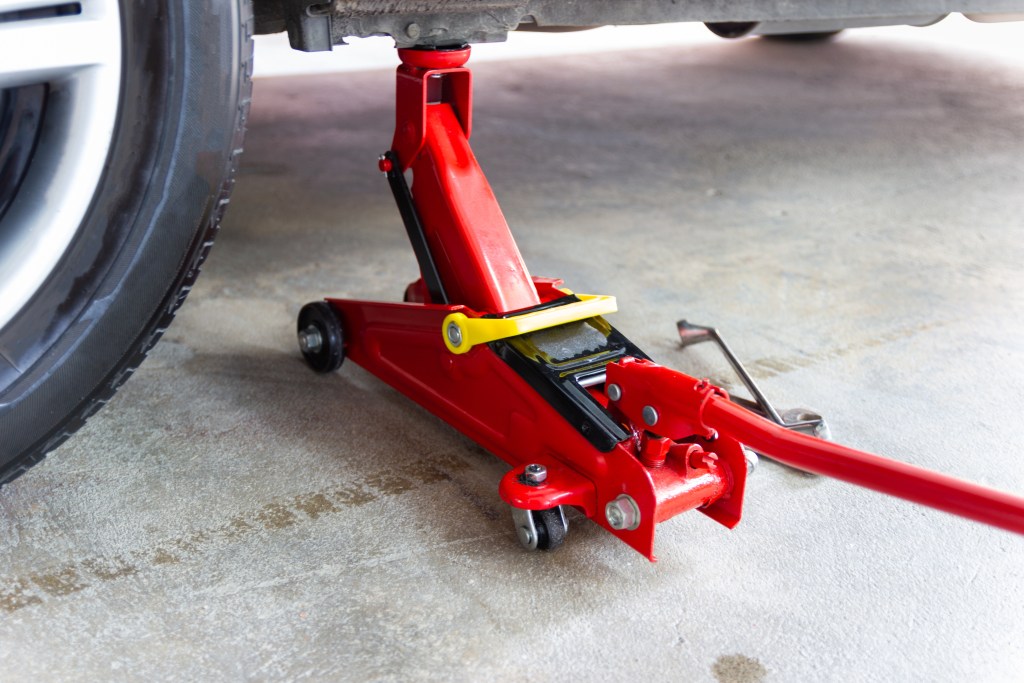
Last year in Ashland, Oregon, a service technician was killed by a mistake that can happen to dealership service employees: getting under a vehicle that’s up on a jack with nothing else holding it. The tech had the axles up on a bottle jack, put nothing under the load, and was crushed when it came down. OSHA found no blocks, no cribbing, no stands. Just the jack. Technicians work off lifts most of the day, but the jack still comes out for mobile calls, and the moment one of them gets under a load on a jack alone, this is the risk they’re taking.
The employer wasn’t a dealership. It operated fueling stations and did truck repair and maintenance. But OSHA cited it for four things, and every one lands in a service department. The first is the blocking failure, and it’s no gray area: 29 CFR 1910.244(a)(2)(iii) requires that once a jack raises a load, it be “cribbed, blocked, or otherwise secured at once.” On the floor that means stands rated for the weight, set on solid, level ground, under the vehicle before a tech reaches in. Second, nobody made sure the rig was shut off with the brakes set before work began, cited under OAR 437-002-2225(8)(b), Oregon’s own rule with no clean federal counterpart. The discipline in the bay is the same: engine off, keys out, in park, parking brake on, wheels chocked, because a vehicle that can roll or crank can move with someone under it. That feeds the third citation, a lockout/tagout violation under 29 CFR 1910.147; for most jack work, controlling that energy just means securing the vehicle first, while full written LOTO comes in with shop equipment and any job where stored or leftover energy can turn loose. Fourth, they reported the death late: under 29 CFR 1904.39, a work-related fatality goes to OSHA within 8 hours and an in-patient hospitalization, amputation, or loss of an eye within 24, and the clock starts when the incident happens or when the employer learns of it, not once the cause has been sorted out.
Mobile techs are the most exposed
The Oregon job was a mobile call, not a shop repair, and it’s exactly the work a dealership’s mobile program does: a tech on a portable jack, on ground nobody prepared for lifting, with none of the gear a shop has.
Mobile service is also a newer offering for many dealerships. A number of stores have launched these programs quickly to grow fixed operations and retain customers, and it isn’t always obvious that mobile work carries different exposures than the service bay. OSHA’s rules do not relax because the work is performed off-site; 1910.244(a)(2)(iii) and the reporting rules apply to the technician in a driveway exactly as they do in the shop. Extending that program to the mobile unit means rated jack stands and load-spreading boards in every vehicle, a firm rule that no vehicle is worked under until stands are set and the ground has been checked, a prohibition on lifting on soft or sloped surfaces, and a check-in procedure so the location of each technician is always known.
Key practices for the service department
- A jack raises a vehicle; jack stands support it. Stands must be in place before any technician works underneath, without exception.
- Rate the jack and stands for the vehicle’s weight, and position them on firm, level ground at the manufacturer’s designated lift points.
- Before raising the vehicle, confirm the engine is off, the keys are removed, the transmission is in park, the parking brake is set, and the wheels are chocked.
- On mobile calls, assess the ground before lifting, carry boards to distribute the load, do not lift on soft or sloped surfaces, and maintain a check-in procedure.
The safeguard that was missing in Oregon takes only seconds to put in place. The employer’s penalty settled at roughly $15,000; the cost to the technician’s family was far greater. This is neither an expensive nor a complicated fix. It is a matter of consistent practice, applied every time a vehicle is raised, whether in the service bay or in a customer’s driveway.
ComplyAuto Can Help
Keeping up with OSHA requirements across one dealership is challenging enough. Keeping multiple rooftops aligned is even harder. Whether you’re addressing housekeeping issues, lift inspections, eyewash stations, or other workplace hazards, ComplyAuto Safety gives your team a centralized platform to identify risks before OSHA does and ensure corrective actions are completed across every location. Schedule a demo to see how ComplyAuto Safety can help strengthen your dealership’s safety program and reduce compliance risk.
Source: Oregon OSHA fatal-incident alert, Health and Safety Resource, July 2026.