
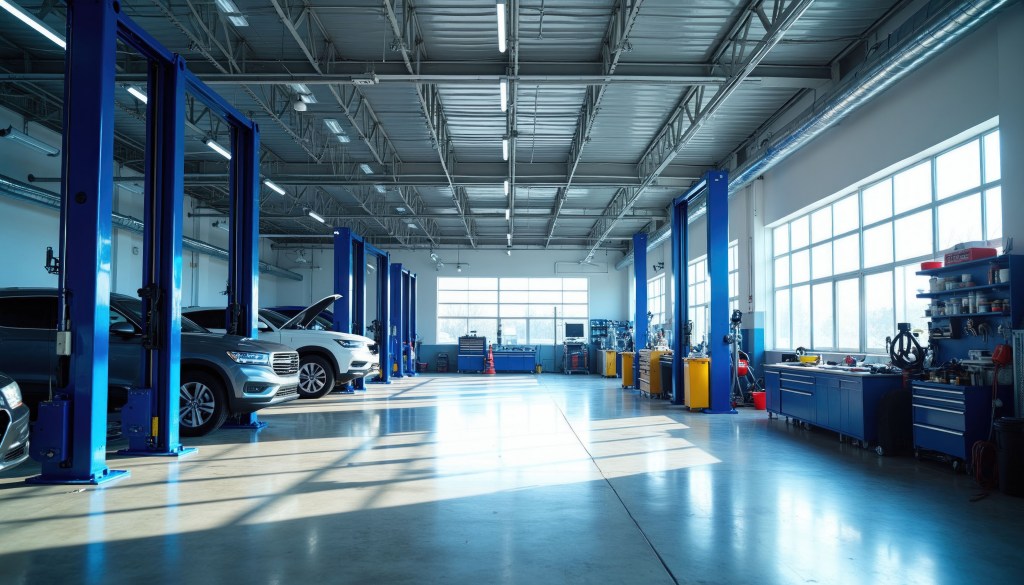
When dealers think about service department safety, the obvious risks come to mind first: lift inspections, eye protection, lockout/tagout, falls in the bays. Hearing loss usually sits lower on the list. The conversation often stops at reminding techs to wear earplugs near the impact gun.
A new study from the National Institute for Occupational Safety and Health (NIOSH) should change that conversation. Researchers looked at survey data from more than 17,000 U.S. workers. They wanted to find out how many workers are exposed to two things that damage hearing: loud noise, and a group of chemicals called ototoxic chemicals.
The big finding for dealers: workers in installation, maintenance, and repair jobs had the highest rate of ototoxic chemical exposure of any job in the study. That category covers most of the back half of a dealership. It includes automotive service technicians, body shop technicians, glass installers, diesel and truck technicians, mobile electronics installers, and their direct supervisors. Forty-three percent of these workers said they were exposed to ototoxic chemicals at work in the past year. Forty-two percent said they were exposed to loud noise. Twenty-nine percent said they were exposed to both.
What Ototoxic Chemicals Are, and Why Dealers Should Care
“Ototoxic” means “harmful to the ear.” Ototoxic chemicals damage hearing in one of three ways. Some of them hurt the inner ear directly. Some hurt the nerves that carry sound to the brain. And some make noise damage worse than it would be on its own.
The chemicals fall into five main groups: solvents, heavy metals, nitriles, certain medicines, and asphyxiants (gases that block oxygen). The ones most likely to show up in a dealership include toluene, xylene, styrene, ethylbenzene, trichloroethylene, lead, carbon monoxide, and the fumes from gasoline and diesel exhaust.
Why does this matter? Because for some of these chemicals, the two hazards do more together than either does alone. NIOSH and OSHA have warned of this synergistic effect: certain ototoxic chemicals make the ear more vulnerable to noise, which is why hearing protection alone may not be enough when both are present. A tech who spends his morning doing brake jobs with aerosol cleaners and his afternoon next to an impact wrench is not simply facing two separate hazards. The combination is its own concern.
The study found that workers exposed to both noise and ototoxic chemicals had more hearing problems than workers exposed to either one alone. Of the hearing difficulty cases among workers with both exposures, 42 percent were attributable to those workplace exposures.
Where the Exposures Actually Happen in a Dealership
The study reports numbers by industry and occupation, but the chemicals and noise sources behind those numbers show up in specific places in a dealership. Here is where to look:
Brake service. Aerosol brake cleaners often contain toluene or other ototoxic solvents. Brake dust on older vehicles may still contain small amounts of heavy metals.
Engine work and idling vehicles. Both gasoline and diesel exhaust contain carbon monoxide, which is ototoxic. Even with bay doors open, running vehicles produce exhaust that techs breathe. Quick lube bays and pre-delivery inspection areas where engines run for a long time deserve special attention.
Body shop. Body fillers contain styrene, which is a known ototoxic chemical. Refinish paints, primers, and clearcoats contain toluene, xylene, and ethylbenzene. Paint thinners and prep solvents add to the list.
Parts cleaning. Solvent parts washers, aerosol cleaners, and carb cleaners often contain toluene, xylene, or similar solvents. Closed-loop washers reduce exposure but do not remove it.
Welding and grinding. Welding produces metal fumes. The metals depend on what is being welded, but heavy metals can be present. Working on older vehicles, batteries, or wheel weights can still mean small lead exposures.
Detail and reconditioning. Solvent-based cleaners, adhesive removers, and some tire dressings contain ototoxic solvents. Detail bays are also loud, with wet-dry vacs, polishers, and air compressors running.
Outdoor lot work. Lot porters, fuel attendants, and PDI staff spend their shifts close to engine exhaust.
The noise side is just as familiar. Pneumatic impact wrenches often go over 100 decibels at the operator’s ear. Tire machines, body shop sanders and grinders, plasma cutters, high-pressure parts cleaners, and the steady hum of air compressors all add up. A tech does not need to stand under a press to take in damaging noise over an eight-hour shift.
The Gap in the Rules
Here is the part dealers need to understand. OSHA’s noise rule, 29 CFR 1910.95, says employers must run a hearing conservation program when a worker’s average noise exposure over eight hours hits 85 decibels. That rule does not say anything about chemicals. OSHA’s Hazard Communication rule, 29 CFR 1910.1200, requires labeling, safety data sheets, and training for hazardous chemicals. But it does not single out ototoxic chemicals, and it does not require any hearing tests.
So under current federal law, dealers are not required to enroll workers in a hearing conservation program based only on chemical exposure. NIOSH and OSHA put out a joint bulletin in 2018 (SHIB 03-08-2018, NIOSH Publication 2018-124) aimed at this overlap. It recommended audiometric testing along with hearing protection for workers facing both noise and ototoxic chemicals, and it stressed that this can be worthwhile even when the noise stays below the OSHA action level and the chemicals stay below their permissible exposure limits. The point was that the combination can warrant hearing monitoring that neither exposure alone would trigger. But this was a recommendation, not a rule.
What Dealers Can Do
Industrial hygienists use something called the hierarchy of controls. The idea is simple: some safety steps work better than others, so try the strongest steps first.
Step 1, eliminate the hazard. A solvent-free brake cleaner removes the chemical exposure. An electric impact wrench used for non-critical fasteners removes the noise.
Step 2, substitute a safer option. Low-VOC paints, water-based cleaners, and quieter air tools reduce exposure even when they cannot remove it.
Step 3, use engineering controls. Tailpipe exhaust extraction systems, local exhaust at body shop sanding and welding stations, enclosed compressors, and acoustic panels on bay walls all help with both noise and chemicals.
Step 4, use administrative controls. Rotate techs out of the highest-exposure tasks when possible. Limit unnecessary engine running in enclosed bays. Schedule loud or solvent-heavy work so fewer workers are exposed at once.
Step 5, use personal protective equipment. Hearing protection rated for the actual noise level. Chemical gloves. Respirators when the safety data sheet and an exposure assessment call for them. Eye protection.
Beyond controls, dealers with exposed techs should think about offering yearly audiograms to workers with significant chemical exposure, even if their noise level alone would not trigger the OSHA program. The cost of an annual hearing test is small compared to a workers’ comp claim for hearing loss that took years to develop and is only caught after the damage is done.
The Bottom Line
The NIOSH researchers estimate that across the U.S., 1.4 million extra cases of hearing difficulty are tied to ototoxic chemical exposure at work. Another million are tied to the combined effect of noise and chemicals. Dealership service operations have a piece of both.
Hearing loss is one of the most common permanent work-related illnesses in the country. Unlike a cut or a sprain, it does not heal. Dealers who treat ototoxic chemicals as part of the hearing picture, not just a hazcom problem, will be ahead of where the rules are likely to go, and ahead of where their workers’ comp carriers are likely to start asking questions.
How ComplyAuto Can Help
The chemical side of this hazard is already part of what ComplyAuto’s Safety platform does. The solvents, fuels, and metals that drive ototoxic exposure are the same hazardous chemicals ComplyAuto helps you manage through hazard communication, your SDS library, PPE, and technician training. Identifying which chemicals in your shop are ototoxic, and pairing that with the right PPE and training, is the part of the hearing picture a dealer can act on today.
Reference: Masterson EA, Morata TC, Themann CL. Prevalence of Ototoxic Chemical Exposure, Noise Exposure and Hearing Difficulty Among Workers in the United States, 2023. J Occup Environ Med. 2025 Oct 1;67(10):785-797. doi: 10.1097/JOM.0000000000003445.