
On July 13, 2026, the U.S. Department of Labor announced a settlement with national auto service chain Monro Inc. to resolve a series of safety violations OSHA identified at the company’s Norwich, New York, store. Monro will pay $174,000 in penalties, correct every cited condition, and stand up a free, anonymous hotline so employees across its roughly 1,100 locations can report safety and health concerns directly to corporate safety staff. This was not a random visit. The inspection started as a complaint-driven, partial-scope safety inspection. Someone, almost always a current or former employee, put OSHA on notice.
What OSHA Found, Standard by Standard
Slip, trip, and fall hazards — 29 CFR 1910.22(a)(1). Inspectors documented engine oil and transmission fluid spilled on a storage-room floor, plus an exterior area piled with commercial trash and scrap tires. The walking-working-surfaces rule requires that all work areas, storerooms, and passageways be kept clean, orderly, and sanitary. In a shop, this is a housekeeping-SOP problem, not an engineering one: spill response, absorbent stations, and a scrap-tire and waste-removal cadence that doesn’t let clutter accumulate.
Oily rags — 29 CFR 1910.106(e)(9)(iii). OSHA found used, oily rags allowed to pile up rather than being kept in covered metal containers. This is the flammable-liquids housekeeping provision, and it exists because oil-soaked textiles are a spontaneous-combustion risk. The fix is inexpensive and unambiguous: self-closing, listed oily-waste cans, emptied on a set schedule.
Emergency eyewash — 29 CFR 1910.151(c). Employees performing battery maintenance did not have a suitable eyewash station nearby. Where the eyes or body may be exposed to injurious corrosive materials — and battery electrolyte (sulfuric acid) qualifies — the standard requires facilities for quick drenching or flushing within the work area for immediate use. “Nearby” is the operative word; a wash station across the shop doesn’t satisfy the intent.
Electrical hazards — 29 CFR 1910.303(b)(1) and 1910.305(j)(1)(i). Inspectors cited damaged outlets and electrical conduits. Subpart S requires that electrical equipment be free of recognized hazards and that wiring components in general use be maintained in safe condition. Damaged conduit and receptacles are a routine finding in older shop bays and a routine citation.
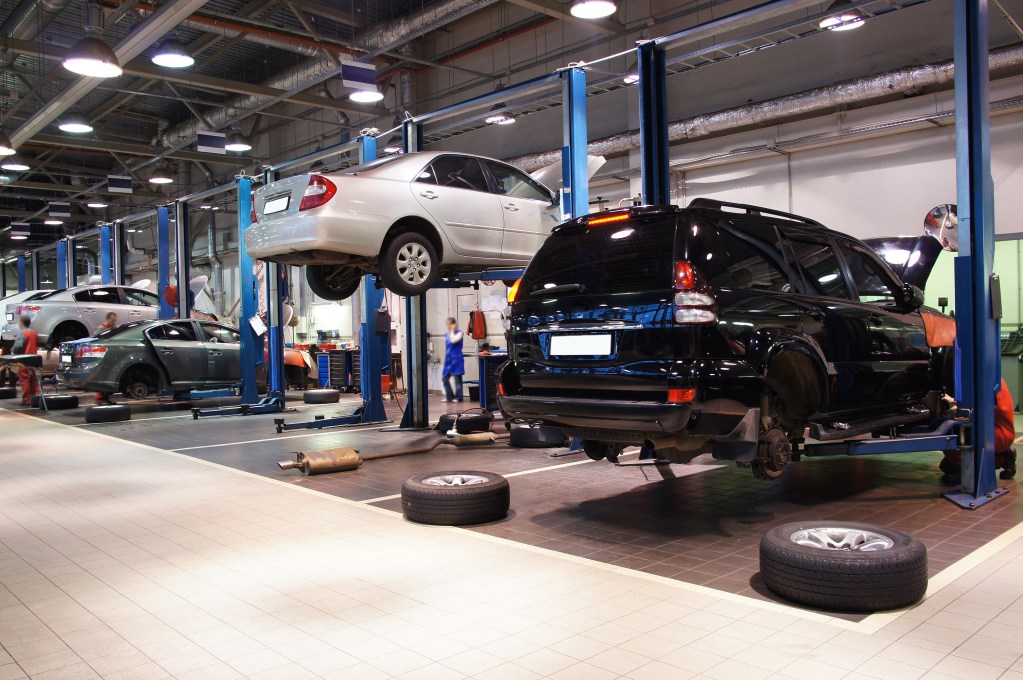
Crushing hazard (Repeat) — General Duty Clause, Section 5(a)(1). OSHA found a four-post rotary lift whose broken safety-latch cable had been “temporarily” secured with a pair of vice grips. Because no single vertical standard squarely governs that specific defeat of a lift’s safety device, OSHA reached for Section 5(a)(1), which obligates every employer to furnish a workplace free from recognized hazards likely to cause death or serious physical harm. A defeated lift latch under a raised vehicle is about as clear a “recognized hazard” as exists in a shop.
Why the “Repeat” Classification Is the One To Watch
Of everything OSHA cited, the repeat violation carries the most weight. By statute, a repeat violation can be penalized at up to roughly ten times the maximum for a serious violation. OSHA classifies a violation as “repeat” when an employer has previously been cited for a substantially similar hazard. For a single-location business, that predicate has to come from its own past. But for a multi-establishment company, OSHA can base a repeat on a substantially similar violation cited at any of the employer’s locations. For dealer groups, if you operate more than one rooftop under common ownership, a hazard OSHA cited at your Store A can become the predicate for a repeat citation — with dramatically higher penalties — at your Store B months or years later, even under a different manager. Correcting a finding at the store where it was cited is not enough. The correction has to propagate to every location that shares the same equipment, the same SOPs, and the same corporate parent.
Your Service-Department Takeaways
Every condition in this case is preventable with routine discipline. Use the citations as a self-audit:
- Floors and housekeeping. Spill-response supplies at every bay, a documented cleanup cadence, and no accumulation of trash, scrap tires, or clutter in interior or exterior storage.
- Oily rags. Covered, self-closing metal oily-waste containers, emptied on a set schedule. Cheapest fix on this list; still gets cited constantly.
- Eyewash. A suitable, unobstructed eyewash within the immediate work area anywhere batteries or other corrosives are handled — inspected and flushed on schedule.
- Electrical. Regular walk-throughs for damaged receptacles, cords, and conduit; tag and repair rather than work around.
- Lifts. Never defeat or improvise a safety device. Document ALI/manufacturer-aligned periodic lift inspections, and pull any lift with a compromised latch or cable out of service until it’s properly repaired.
The Bottom Line
Monro’s $174,000 settlement is a reminder that OSHA’s most common and most expensive findings in vehicle service aren’t complex engineering failures. They’re housekeeping, a missing wash station, a worn-out cord, and a safety device someone decided to work around. For any dealership group running service or body operations across more than one rooftop, the strategic lesson is consistency: standardized SOPs, documented inspections, and corrective actions that propagate to every location.
ComplyAuto Can Help
Keeping up with OSHA requirements across one dealership is challenging enough. Keeping multiple rooftops aligned is even harder. Whether you’re addressing housekeeping issues, lift inspections, eyewash stations, or other workplace hazards, ComplyAuto Safety gives your team a centralized platform to identify risks before OSHA does and ensure corrective actions are completed across every location. Schedule a demo to see how ComplyAuto Safety can help strengthen your dealership’s safety program and reduce compliance risk.